An example for the information content of a StandardSSC

Oldenburg, Lower Saxony, D / Torunsko-Wloclawski, Kujawsko-Pomorskie, PL

  • Location of the sites to be compared

    The SSC was elaborated for an indication of spring barley, a fungal disease and a fungicide.

    In Addition to the analysis of the satellite image data, the StandardSSC is extended to the analysis of parameters like soil characteristics, land use, climate and phenology.

    We would be pleased to send you a complete example of a StandardSSC via email. Do not hesitate to fill in our contact form with name and email and you will soon receive the complete SSC as a PDF document.


  • Comparison of Satellite images CW19 and 20

    The satellite images of the vegetation development

    The satellite images visualise the long-term average of the vegetation index NDVI (Normalized Difference Vegetation Index) in the regions Oldenburg and Torunsko-Wloclawski in weeks 17 to 23 (April to June).

    The satellite images show whether the biomass and vitality of the vegetation and the crops is high or low. Week after week, they provide a look at the state and the growth intensity of the crops which depend on the site-specific growing conditions.

    The colouring of the satellite images proves that the growth intensity of crops are similar in terms of biomass and vitality in both regions.


  • Developing of the vegetation indices

    The vegetation index of arable land

    The figure shows the averaged NDVI values of arable land per calendar week for the sites Oldenburg and Torunsko-Wloclawski, derived from 12 years´ measurements (1995-2006) throughout the growth period from April to July.

    The course of the vegetation indices are almost identical in both regions.

    Especially in May until mid June (cw 18-23), during the important phase of plant growth and the period of the occurrence of the pest and the treatment with the plant protection product, the NDVI values are on a similar level.


  • Land use in Oldenburg and Torunsko-Wlodawski

    Soil characteristics and land use

    The topology of the Oldenburg region is mainly flat, with elevations of 2-55 m above sea level. The natural region East Frisian Oldenburg Geest is covered by glacial deposits. The most frequently encountered type of soil is a Dystric Gleysol (by FAO).


  • Land use statistics of both regions

    The landscape in the region Torunsko-Wloclawski is dominated by hills, broken by valleys and numerous rivers that arise in this region. A variety of glacial waters is typical of this region of the Southern Baltic Lakes (Pojezierza Poludniowobaltyckie). Because of the geological character Gleyic Luvisols, Orthic Luvisols and Leptic Podzol (by FAO) dominate.

    The above figure shows the land use in both regions.

    In Oldenburg 65.9% of the area is agricultural land, in Torunsko-Wloclawski 72.4%. In both locations 75% of arable area is cultivated with cereals (including maize).


  • Time range of occurence of phenology stages

    Phenology

    The phenology assists in the characterisation of regions and the presentation of their similarity.

    In this example spring barley is used as indicator crop for the phenological conditions typically occurring in the two sites to be compared.

    The table above shows the phenology of spring barley grown in the Oldenburg and Torunsko-Wloclawski region. The coloured bars visualise the time range in which the phenological stages started during the years 1999 until 2006.

    The phenology dates of spring barley in both regions show a high similarity .

    Of course, it has to be taken into consideration that variations in phenology between years and regions occur due to regional differences in, e.g., sowing dates, varieties, fertilisation and plant protection treatments.

    These man-made influences having been taken into account, the phenological parameter of both regions shows a sufficient similarity.


  • Comparison of the weather conditions

    Weather

    Also in terms of weather conditions, the regions show similarity during the relevant period.

    The long-term monthly averages of daily mean temperature and precipitation from 30 years of measurements (1971-2000) show no significant differences between the two regions from April to June.


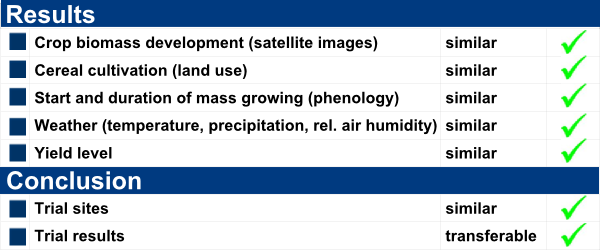
  • Positive outcome of a StandardSSC

    Result and Conclusion

    The similar development of the plants is confirmed by the results of the analysis of the additional parameters. Thereafter, the regions are similar. The field trial results can be transferred.